
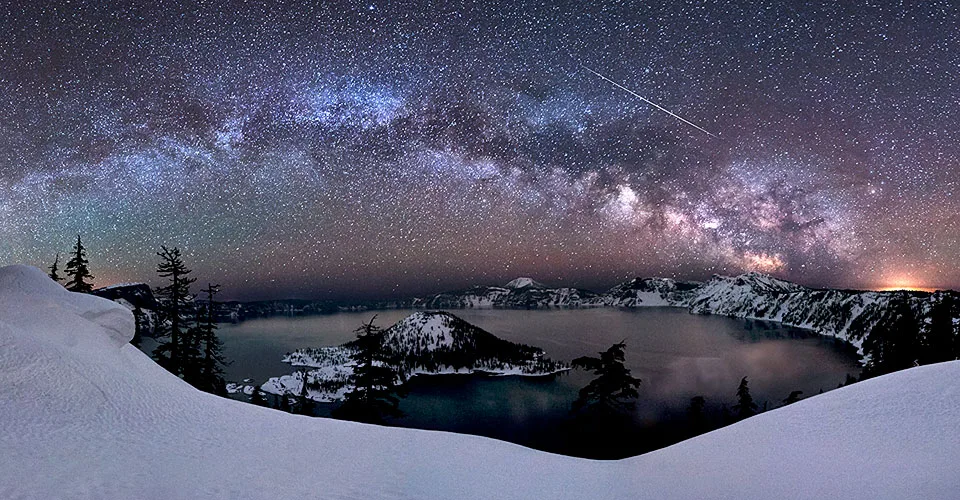
Beyond the Rim
Crater Lake National Park, located high within the Cascade Mountains, provides visitors with knowledge and beauty the way her volcanic eruption produced lava 7700 years ago—steadily flowing with periodic bursts of insight and wonder. Her indigenous allure aroused deeper exploration, so I detoured off the grid and slowly trudged into the forested abyss. Just beyond the icy caldera rim, America’s deepest lake mirrored the prodigy of the night and created a liquid snapshot of man versus nature.
My latest image, “Beyond the Rim” was chosen as NASA’s Astronomy Picture of the Day (APOD) and is displayed today, April 25, 2012 on its website http://apod.nasa.gov/apod/ap120425.html. Each day an image or photograph relating to our universe is chosen by Astronomer and Astrophysicist Robert J. Nemiroff Ph.D., and Astrophysicist and Staff Scientist Jerry Bonnell, is made available to a huge fan base worldwide, and used as a tool for educational discussion and academic debate. I consider this opportunity a great honor because the APOD archive contains the largest collection of annotated astronomical images on the internet and is a highly respected resource for those in the field.
To purchase prints, visit https://goldpaintphotography.com/purchase/.






10 Responses
Beautiful capture! Shot from the southwest rim, the light on the right would seem to be from the east northeast. It sure looks like a rising sun to me.
Michael,
Thank you for your comment. These images were taken around 1:30am; definitely not the rising sun. Please see my previous comments above for an explanation.
Brad
Would you mind sharing a bit about how you took this picture? Particularly how you got such nice clarity of the sky. I assume you have to stack multiple images, but then do you have to layer the stacked image behind a shot of the ground, since one is moving and the other isn’t? What kind of exposure times did you need? And the colors in the milky way are amazing – did it require your camera to be modified to have the Ha filter removed?
Wonderful picture, and congrats on making APOD!
John,
Thank you for your compliments. In order to maintain the integrity of photographic moments and avoid sabotaging the efforts of other professionals, the details of my techniques are kept confidential. If you are interested in learning more about landscape astrophotography, I offer private and small group workshops. For more info, visit https://goldpaintphotography.com/workshops/.
Stunning! For sale?
Pat,
All of my images are for sale. Please see my purchase page, https://goldpaintphotography.com/purchase/, for more info.
Thank you
The longer I look at the photograph, Brad, the more intrigued and amazed I am at the beauty you’ve captured there.
I’ve pinned it (http://pinterest.com/pin/146648531586553583/) and posted it to Facebook (https://www.facebook.com/writerChristine). Thanks for allowing us to enjoy your work.
Thank you for sharing, Christine!
Gorgeous picture. What’s the glow on the right? Sunset or the lights of Eugene?
Caryn,
Eugene is actually in the opposite direction. It is definitely light pollution, but I’m not sure where it is exactly coming from. My best guess would be Klamath Falls.