
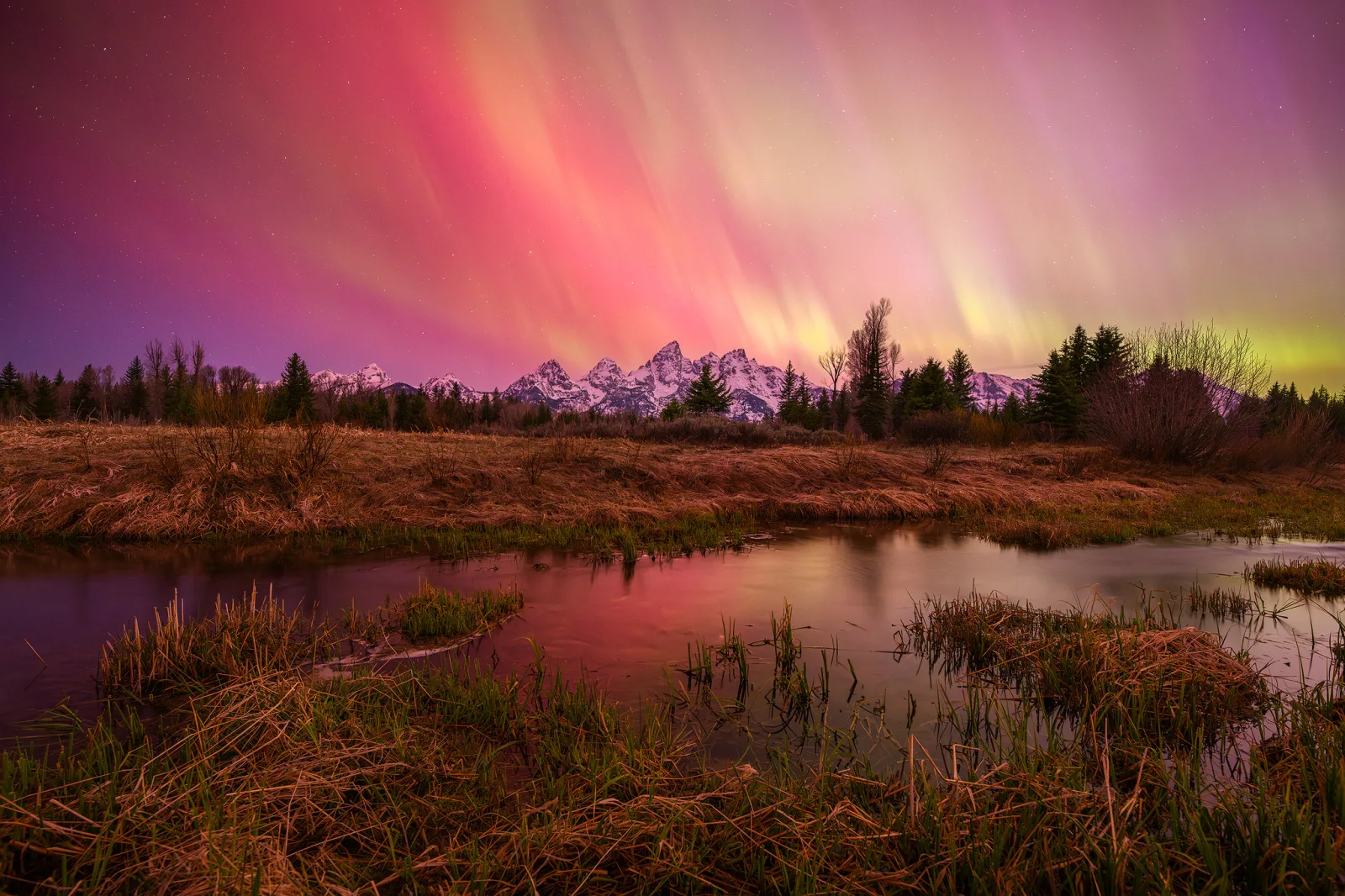
I had dreamed of seeing the aurora borealis for as long as I can remember. What unfolded on May 10, 2024, in Grand Teton National Park was nothing like what I had ever imagined. Exploding waves of green, red, and purple swept across the entire sky, vivid and unmistakable, visible to the naked eye, and one of the most beautiful sites I had ever witnessed. What made this storm so historic and why was it so powerful?
+ MY JOURNEY
My journey began on the morning of May 10, 2024, in Central Utah. I was recovering from teaching a night photography workshop, sipping coffee, and checking my usual astronomy and space weather websites. One headline immediately caught my attention:
“GET READY FOR A CANNIBAL CME.”
Multiple CMEs (Coronal Mass Ejections) were heading for Earth. A new NOAA forecast model suggested that three of them could merge to form a potent “Cannibal CME.” Cannibal CMEs form when fast-moving CMEs overtake slower CMEs in front of them. NOAA was predicting a severe storm on May 11 when the Cannibal would arrive. -spaceweather.com
Normally, I would have met this article with a lot of speculation. Solar storms happen regularly, especially during solar maximum, but no one really knows what CMEs will produce when they arrive. Generally, where I lived in the Pacific Northwest, the aurora usually appears only as faint pink or white streaks of light along the northern horizon. My previous experiences capturing auroras over Crater Lake National Park, Sparks Lake, and the peaks of the Cascade Range had been extremely lucky and memorable, but none were comparable to the displays seen closer to the poles.
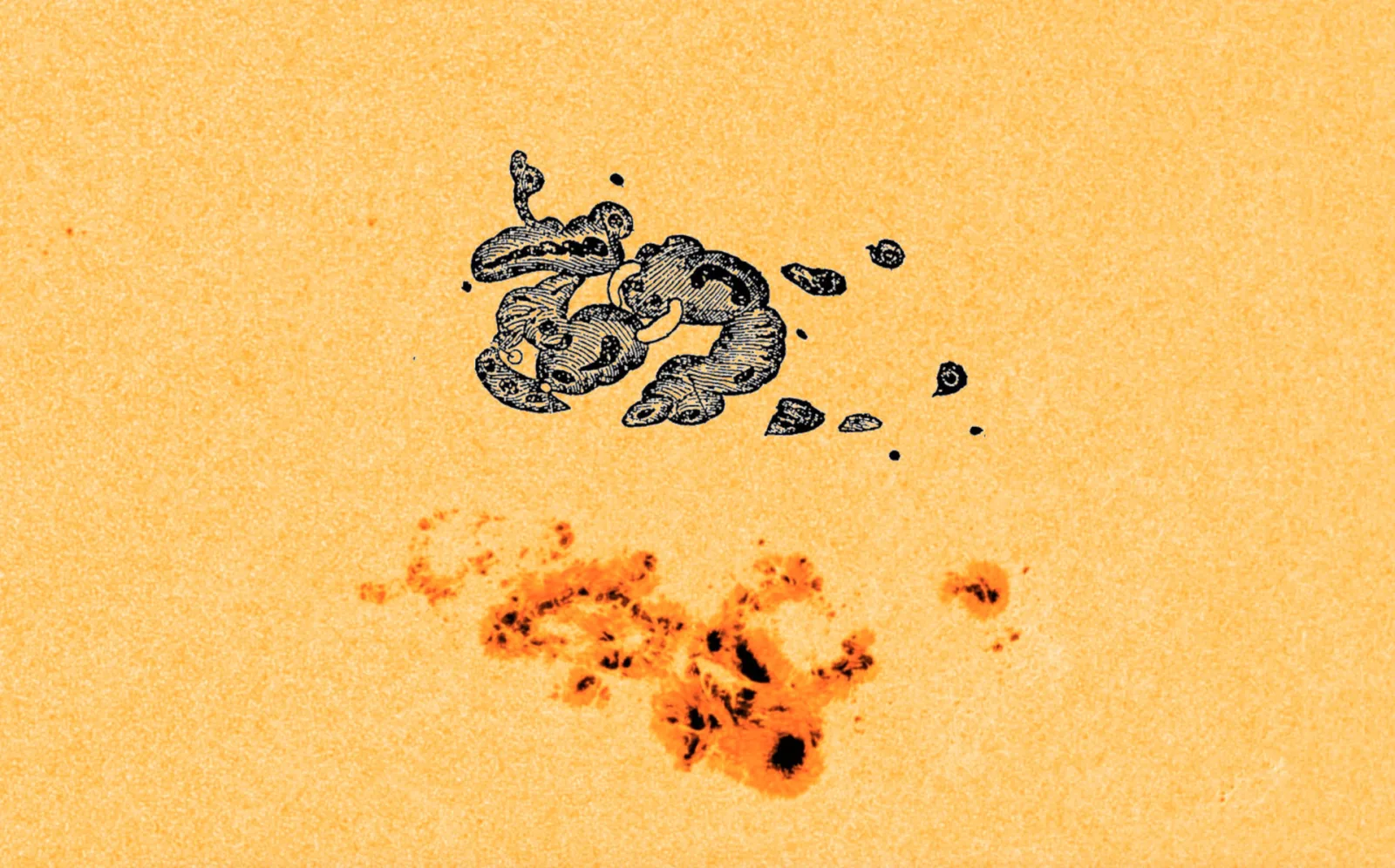
My speculation quickly vanished when I saw the image of sunspot AR3664. The size and intensity of this sunspot were very impressive. AR3664 had released six CMEs, all directly facing Earth. The comparison image next to the historic Carrington Event of 1859 made this impossible to ignore.
+ THE CARRINGTON EVENT
On September 1, 1859, the most intense solar storm in recorded history engulfed our planet. “The Carrington Event,” named after British scientist Richard Carrington, who witnessed the instigating solar flare, sparked auroras from Cuba to Hawaii, set fire to telegraph stations, and wrote itself into history books as the largest solar storm ever recorded.
I started checking weather forecasts. Nothing within a hundred miles showed clear skies, so I looked farther north. That’s when Grand Teton National Park appeared on the map, showing two full days of clear skies. I had never been there and had no idea what to expect. I followed my intuition, packed up my gear, locked down my truck camper, and began the ten-hour drive north.
+ The entire sky was alive

Somewhere along the way, I called my friend Evie, who knew the park well. She gave me coordinates, photo locations, ideas, and encouragement to keep pushing. In a race against the setting sun, exhausted, hungry, and running on pure adrenaline, I arrived at a small overlook just outside the national park. As twilight began to fade, I stumbled out of my truck and saw photographers and stargazers who had already gathered with cameras and cell phones in hand. I walked a short distance away from the crowd, set up my camera, and aimed my lens at the Teton Range and crescent moon. The first test shot revealed more colors of the aurora than I had ever captured before. The distant jagged mountain peaks were covered in a symphony of green, red, pink, and purple hues. In between the jagged peaks, snowbanks reflected the same story my camera was capturing, reflecting the soft purple pastels dancing everywhere in the sky.
After I reviewed the image in disbelief, I looked up and saw some of the colors my camera was capturing. Green spires of light rose and twisted into subtle ribbons out of the Teton Range, moving across the sky with remarkable speed. Within minutes, the entire sky appeared alive and evolving, in what I can only describe as a symphony of light, orchestrated and conducted by a power far greater than anything I could ever comprehend.
I adjusted exposure settings repeatedly. Twenty seconds was too long and too bright. Five seconds blurred the light’s movement. Two and a half seconds finally captured the detail and motion as it rapidly transformed. I quickly snapped the panorama above and immediately felt an overwhelming sense of accomplishment. I thought to myself, ‘That’s it… it’s already been worth the drive and I can go home happy.’ Little did I know, this was only the beginning.

+ THE PEAK OF THE STORM
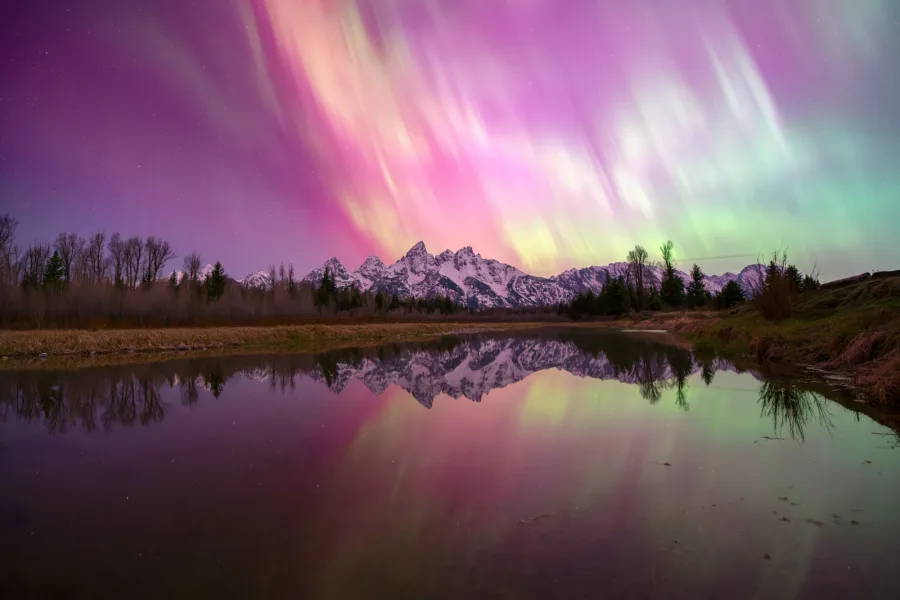
When I reached the pond, I set up both cameras and looked up again. The entire sky was on fire. Sheets of light folded and rolled across the stars, like ocean waves breaking in slow motion. Each ripple transformed into a different color, and each wave moved faster as the show continued. The reflection on the still water doubled the scene, and for a few moments, it felt like the ground and sky had traded places.

As I stared in disbelief, the peak of the storm began to unfold in every possible direction. The auroras danced above Grand Teton National Park, transforming into a living tapestry of light, weaving, crashing, and unraveling in ceaseless motion. The colors rippled, collided, flickered, and dissolved in ways no camera could ever capture. I stood frozen. Every sense locked onto the spectacle overhead, letting the raw majesty sear into my memory, and allowing myself to breathe in the light.

Below is a short time-lapse video captured with my camera pointed straight up. The camera settings were far different from what I normally use for night photography. This sequence was created from 570 photographs, taken over just under 10 minutes. Each image exposed for only a 1/4 of a second, with one second in-between each image.
Click to Download the Video for a closer look.
They say seeing the aurora is a spiritual experience. I used to think that was a bit of an exaggeration, but I was wrong. I felt it. It was similar to how other had described their experience. In that moment, it wasn’t about the images I was bring back or proof. It was about the presence of something greater than myself, a storm that made the night pulse with what seemed like impossible energy. Every moment stretched, infinite and fragile, and I was suspended within it, fully awake, fully alive, and completely changed.
When twilight started and the display finally began to fade, I lingered. By then, I had been awake for 23 hours. I was exhausted, but completely glowing from the experience.
Grand Teton National Park is breathtaking at any hour, but under the night sky, it becomes extraordinary. If you have ever wanted to see the sky come alive, join us for our limited Grand Teton night photography workshop.









3 Responses
Thank you Brad for sharing this surreal experience/light show that is incredibly unique and awe inspiring!✨💫✨💫✨💫✨ What a blessing that you were able to fulfill a lifelong dream on your photographic journey!
Miss you !!
Thanks for this article.
Wonderful pictures and video!
Love to see on paper to share with my Grandchildren.
How do I buy a copy of a few pictures and maybe download the video?
Hi Ed,
Thanks for checking it out and glad you enjoyed. I added a download button under the video so you can save it to your computer and show your little ones. I hope it inspires them!
If you’re interested in purchasing prints, you can find them in my online store under my Night Sky gallery. Thank you for your support!